Tuesday, August 21, 2012

New Faces


The Crazy Chicken Lady has two new beauties to share, Tramp and Pigeon. They are a beautiful pair of Serama that have come to us all the way from Louisiana.


This tiny, handsome, fellow is "Tramp".

 
This little beauty is Tramp's wife "Pigeon".


"Serama are the smallest and lightest bantam chicken breed in the world. The weight of the serama range from 8 to 16 ounces for hens and from 10 to 19 ounces for cocks. Cocks standing upright, measured from the ground to the comb range from 8-12 inches. The Serama originated in Malaysia and is the result of selective cross breeding of several breeds (the common village bantam and the wild jungle fowl) contributing a bulk of the serama's genes." For more information about Seramas please visit Jerry Schexnayder at http://www.jerrysseramasllc.com/.

The Crazy Chicken Lady loves Serama and hopes to begin her own flock of them starting with these two beauties. We will keep you posted with photos of their babies when they hatch.

Tuesday, August 14, 2012

Gerard

Grieve not,
nor speak of me with tears,
but laugh and talk of me
as if I were beside you -
I loved you so -
'twas Heaven here with you
~Isla Paschal Richardson

Gerard went to be with the Lord 8/8/12

My heart aches at your passing and I cry out for you. You touched my life, you touched my heart, and I will never forget you.

Monday, August 13, 2012

What in the world ...?

Some days you just have to wonder what was going through the mind of the she guinea when she laid her egg?

Saturday, July 28, 2012

Bumble What?

     The other day I was visiting with some of my hen friends when they started to tell me about their concern for The Old Queen. Well you probably remember The Old Queen. She is the flock queen and she is a beautiful older lady who is very fair when it comes to all the politics in the coop. She is the one who stood up for Speckles when The Diva was being rude and mean after Speckles returned from surgery.
     My friend hens said, The Old Queen had an injury on her foot and she was going to have surgery. The hens were worried because the queen would be away from the coop for a few days and hens like The Diva might get out of line.
     You would think that the Blue Roo would keep peace in the coop but he is not that kind of rooster, he is too vain for any of that. It frustrates me to talk about that so in order to keep my hackles down I won't waste any more time on that right now.
     It turns out that The Old Queen had what is known as "Bumblefoot". Bumblefoot is a common infection that poultry and some domesticated rodents get. "Rodents can be domesticated? Hmmm, who knew?" Anyway, due to constant walking on rough surfaces poultry and rodents can get small wounds on the bottom of their feet. These wounds are very susceptible to the bacteria Staphylococcus and they can become very infected. The treatment often requires surgery to open the wound to drain the pus. "Yuck, just the word 'pus' makes me a little queasy."
     You get to have a time warp when you write blogs, (it is in the handbook, really I'm not just making that up) and it has been a few days since The Old Queen had surgery. I'm am happy to report she is completely healed and back to being the wonderful leader and mentor to all of the flock. The Diva did not behave too badly after all. I guess The Old Queen had a talk with her before she went into surgery.

The shepherdess photographed the surgery so that the flock could see it. If you are like me and get queasy at the sight or even mention of blood and pus, just turn off your computer now and go find something else to do. If not, then keep scrolling down. As for me I think I will go chase the Guinea hens.

First all of the supplies for surgery were set out on the counter.


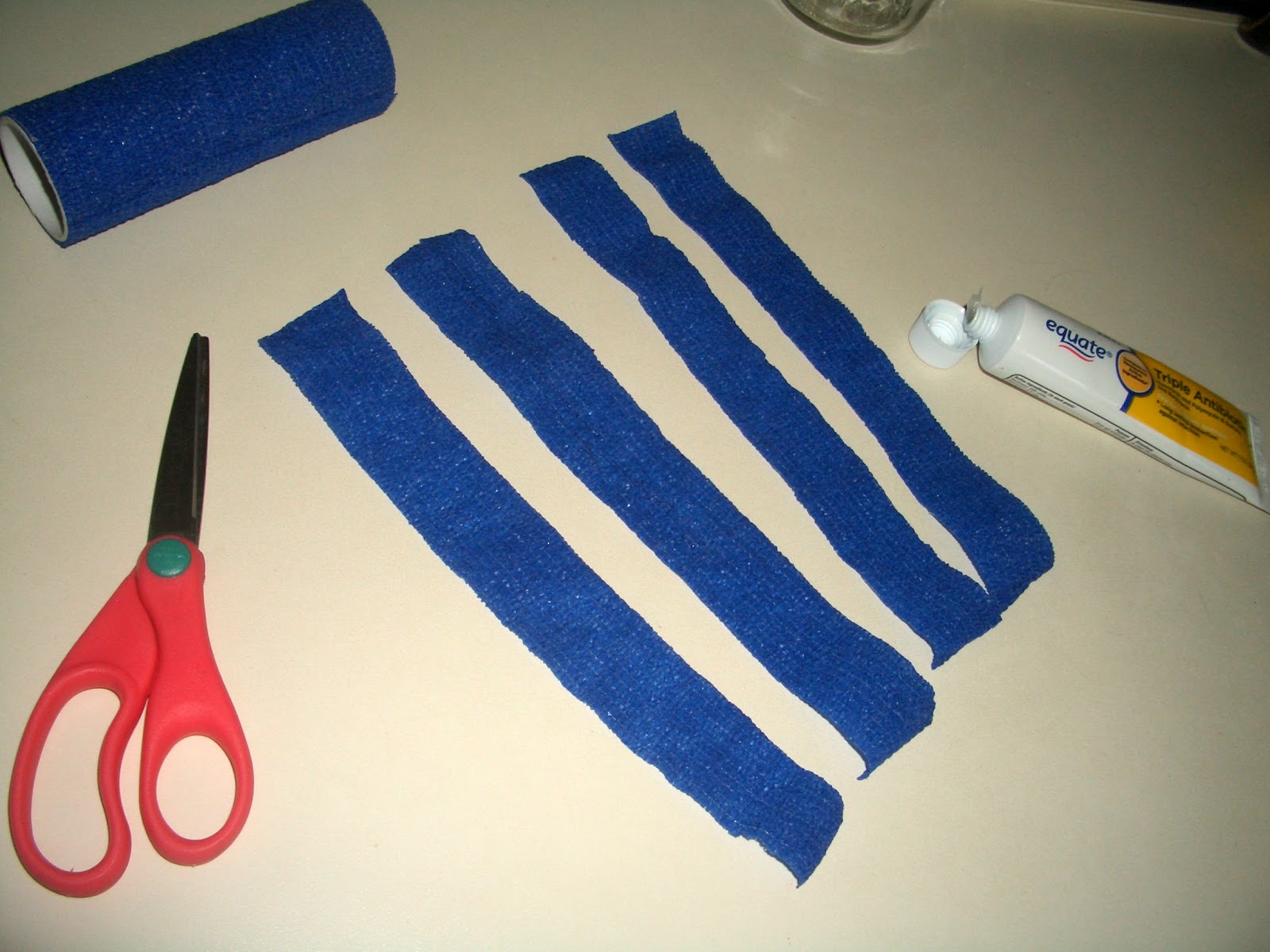
Second all of the bandaging materials for after the surgery were set out on the counter. Those blue things are strips of self-adherent elastic wrap aka: vetwrap or coban.


Next The Old Queen was gently wrapped in a towel so she could relax and take a little nap while she underwent surgery.


The surgical assistant scrubbed The Old Queen's feet to make sure that all of the dirt and debris were gone and so no germs would get into the surgery cite.


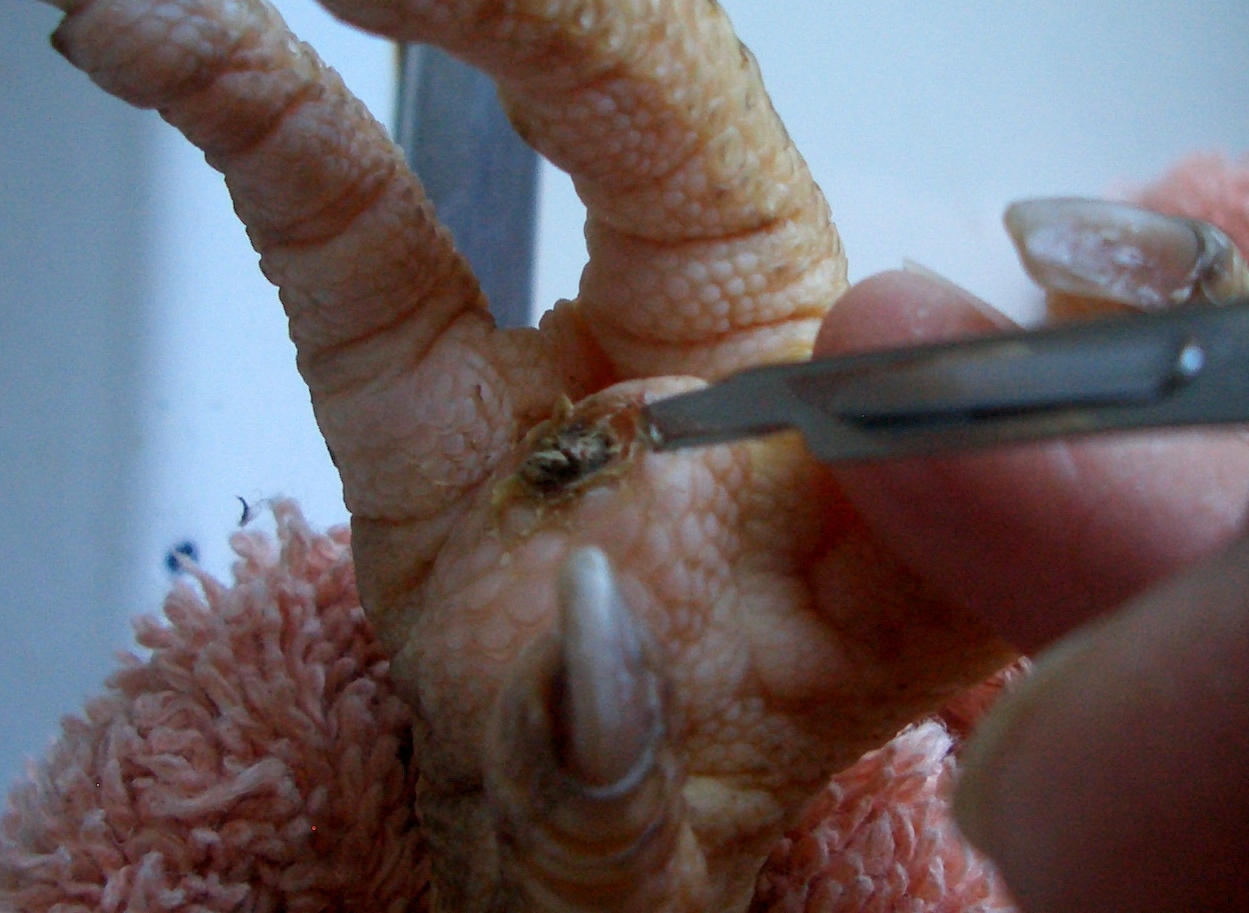
Now surgery begins and the injury is carefully excised (cut away).

There is minimal bleeding and all of the dead and infected skin has been removed.


The wound is then dried and packed with antibiotic ointment.


Last but not least the foot is wrapped with the self-adherent elastic wrap. The Old Queen was then able to walk around without getting her foot infected. The bandages stayed on for 5 days and when they came off she was as good as new.

*Please note ~ all surgical situations should include the use of gloves both for the surgeon's safety and that of  the assistant and the patient! This has been pointed out to our staff and we will wear them with all future medical procedures ~ Thanks Mom.  :-)

Wednesday, July 18, 2012

Newtling?

On a recent trip to see the progression of tadpole to frog at the creek we couldn't believe our eyes. Kyrstyn spotted this little fellow and we thought we were seeing things.


This is a newt larva.


Yes that is what they are called. I was thinking there must be a better name for them but I searched far and wide, on the world wide web, which is a pretty big place ya' know and larva is all I could find. Not like mudpuppy or waterdog that baby salamanders are known as. Hmmm ... seems like we might want to come up with something else and then appeal to the powers that be. I can see it now, "Hello Mr. President, yes well ... we were thinking that maybe we could re-name baby newts with something more fancy than larva ... yes I know there are far more pressing matters but ..."  OK maybe not, perhaps we will just call them something else around here, like "Clyde". 


So just in case you are curious, like I am, newt larva are typically born in the late summer. Fertilized eggs are laid singly on aquatic plants. Unlike eggs from frogs or toads that are laid in clumps or strings. The mother newt folds the plant leaf over so it adheres to the egg to protect it. The egg hatches after about three weeks. The larva eat algae and small invertebrates, like tadpoles.

Saturday, July 7, 2012

Losing Our Tails

On our recent visit to the creek we found that many of the tadpoles (also known as pollywogs or porwigles) have begun their transformation into froghood. They are adorable.

At this stage of a tadpoles life it has just begun to grow hind limbs. Its lungs are now forming inside its body. Soon it will be terrestrial but for now it must remain in water.

 
As the tadpole matures its body slowly absorbs its tail. This process is known as apoptosis. Apoptosis is a process that literally is a programmed cell death. In tadpoles the cells that make up its tail begin to shrink and die off and are reabsorbed by its body.


Once the tadpole has both front and hind limbs it no longer must be in water. However, they still spend a great majority of time in or near water.


 During the final stages of the tadpole's metamorphosis, the tadpole's mouth changes from a small, enclosed mouth at the front of the head to a large mouth the same width as the head. At this point they begin to resemble frogs and no longer look like tadpoles, other than their tail of course.


Wednesday, June 20, 2012

Incubator? What Incubator?

      Remember back in the old days when I got my incubator? When was it.... May 1st maybe? Yes, I think so. Now, do you remember the 23 eggs I had in there? 12 ended up being fertile. Well those eggs hatched. 10 out of 12 eggs. Now they are about a month old. Do you think I'm a little late on posting about them?
      
      They are all fine and growing into total monsters. Oops. Did I say monsters, I meant "angels".... Ya, sure angels. Well that's it for now.


Until next time,
 The Crazy Chicken Lady